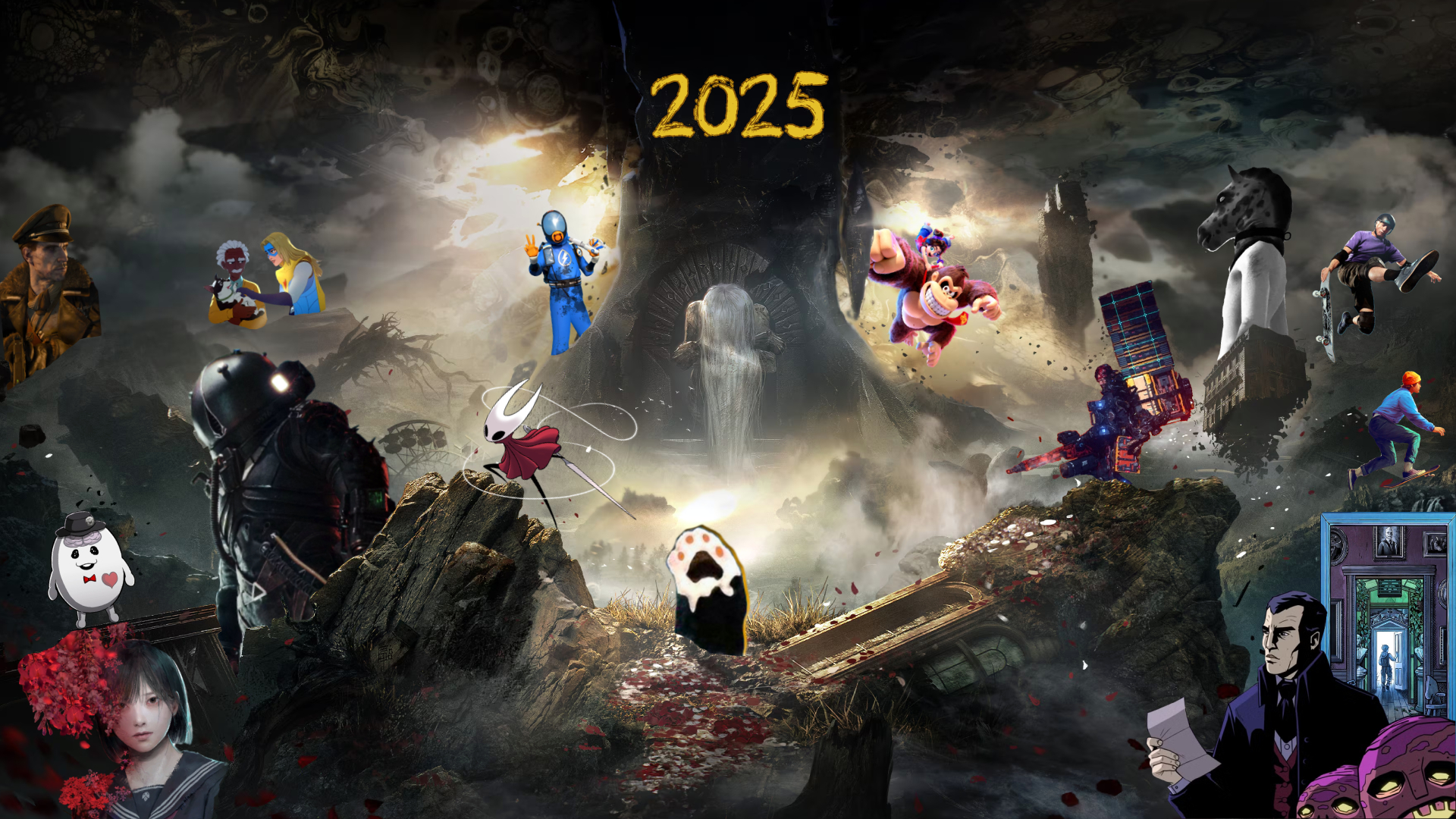
Despite 2025 being a bit of a shiter, there were plenty of games to get stuck into. Here’s my top fifteen of the year. Thanks to anyone who has read or watched my stuff this year. I genuinely appreciate it. Last year, Silent Hill 2 was my Game of the Year. Can Konami go back-to-back, or will Expedition 33 sweep? Read on to find out.
HONOURABLE MENTIONS
- I’ve only finished the first chapter of Skate Story, but it’s a trip. If I’d had more time with it, it almost certainly would’ve landed on the list somewhere.
- I enjoyed the opening hours of Metroid Prime 4, but after running into Breath of the Wild-like Shrines in its barren Desert, I tapped out. Might go back. Might not.
- Mario Kart World is great, but it feels like something is missing from its open world.
- I completed the first area in Hell Is Us and can tell it’s right up my street. I really need to get back to that one.
15. SKATE.
Skate is a funny game. I wasn’t very high on it after my first impressions—it was barren and chock-full of bugs and microtransactions. The vibes are absolutely foul; San Vansterdam feels like a sanitised husk of a city. All of that is still true, yet I find myself logging in several times a week. It’s perfect for quick 20-minute sessions when I get the itch. It’s a shame it isn’t more than that, but I’ll take it. If EA lets Full Circle do its thing, maybe it’ll resemble the Skate 4 everyone hoped for in five years’ time.

14. HOLLOW KNIGHT: SILKSONG
I don’t really want to write about Silksong because people get weird whenever you criticise it. There are moments when it shines, but too often, I was left frustrated by arduous runbacks and unnecessary enemy spam. It’s clearly fantastic, but I don’t have it in me to spend the hours required to “get good”. Gorgeous-looking game, mind you, and it has some memorable encounters. The Last Judge and the Cogwork Dancers in particular were two of my favourites.

13. POWERWASH SIMULATOR 2
I played so much of the first Powerwash Simulator that I ended up buying it multiple times on different platforms. It’s the perfect podcast game. The sequel lives up to the original and is everything I hoped for, though it did take me a while to adjust to some of the changes (thank you, Futurlab, for adding a “classic controls” setting). The soap rework makes bubbling up the dirt even more satisfying, and having a customisable home base is a nice touch. I’ll be playing Powerwash Simulator 2 until there’s nothing left to clean.

12. TONY HAWK’S PRO SKATER 3+4
Another skateboarding game! I never picked a side back in the day between Skate and Tony Hawk, because – much like Battlefield and Call of Duty – they are two very different games. The same is true this year. Unlike Skate, Tony Hawk’s Pro Skater 3 and 4 is a fantastic package full of personality and substance. Remakes are often dismissed as soulless cash-ins, failed attempts to simultaneously relive and improve the past. Not here. The Tony Hawk games feel as culturally relevant now as they did 20 years ago. Classic skaters have aged, passing the torch to younger faces, and the soundtrack fuses legacy artists with newer names.
While the remake of Pro Skater 4 takes some liberties by removing the traditional career mode, it’s still an undeniable joy to skate across iconic locations like San Francisco and Alcatraz. Waterpark, a brand-new map created by developer Iron Galaxy, is another highlight and, if you ask me, proof that the studio should be trusted to make a new entry in the series. I’d settle for a remake of THUG 1 and 2 next, though.

11. HORSES
Horses is a delightfully morbid wee game. It’s a compelling analogy for obedience and control (ironic, considering Steam and Epic controversially decided to ban it), set on a farm in the heat of Summer. Mechanically, there isn’t much going on, but there doesn’t need to be. You wake up, do your work, and tackle the challenges of each day. It’s more of an art piece than a game, if that bothers you. It doesn’t bother me. A game is a game, even if you’re only doing some clicking.
Does Horses deserve to be banned? Not at all. I’d argue several games on this list are far more gruesome and twisted, which makes it all the stranger that this is the one various storefronts have chosen to die on a hill over. While you could argue the debacle has boosted awareness, the decision to ban it on Steam has substantially harmed Santa Ragione’s income. If Horses taught me anything, it’s that we need to stay vigilant about who’s calling the shots—inside and outside of video games.

BONUS AWARDS

10. CALL OF DUTY: BLACK OPS 7
For my full, conflicted thoughts on Black Ops 7, be sure to read my review here.
I’m no stranger to loving a Call of Duty game that gets critically panned; Black Ops 4 is one of my all-time favourites, after all. Botched campaign aside, Black Ops 7 is exactly what I want from a Call of Duty title. Multiplayer has some of the best new maps since the golden era of COD, with a few classics sprinkled in, and all playstyles feel viable. I can run and gun without worrying about movement penalties, while others can take things slower if they prefer.
The game also features the most confident Zombies mode in years. Ashes of the Damned grows far beyond its Tranzit roots to become one of the best Zombies experiences of the Dark Aether era. The return of the original crew – Richtofen, Dempsey, Takeo and Nikolai – could easily have been the kind of mind-numbing nostalgia bait we see everywhere these days, but there is actual substance pushing them into uncharted territory. That said, the very existence of these four variants must be explained thoroughly before the end of the DLC season.
Black Ops 6 might have been a better all-around package at launch, but it never fully catered to hardcore Zombies players, and its post-launch support was a stop-start rollercoaster with squeaky brakes. Black Ops 7 has addressed the former; I pray it improves on the latter as well.
It should go without saying, but fuck the use of generative AI in this game and any other. Unfortunately, I fear the poison of it is only going to spread. One day it’s Calling Cards, the next…

9. DONKEY KONG BANANZA
The Switch 2 finally launched this year, and it’s been worth the wait. It’s the beefed-up Switch with better third-party support and crossplay that I’d hoped for. There have been some big releases, but the lack of new mainline Mario and Zelda games has made the launch year feel a little thin on the first-party front. Out of Mario Kart World, another Zelda mouso, Metroid Prime 4, the self-indulgent Kirby Air Riders, and Donkey Kong Bananza, only one stands tall.
It’s clear Nintendo has big plans for Donkey Kong after his significant role in the Super Mario movie, but for the big guy to thrive, he needed a game that didn’t just feel like a 3D Mario. While Bananza shares plenty of DNA with Mario Odyssey, it still feels like a game only Donkey Kong could star in. After smashing every level of Ingot Isle into rubble, I finally understand why people go to rage rooms. I had concerns pre-launch that battering everything in sight would get old quickly, but it only gets better the longer you play. A lot of care has gone into how each surface interacts with the others, making the later puzzles a decent challenge for a Nintendo platformer.
The same can’t be said for the boss fights, sadly. Most of them are forgettable, and all of them are easy. Between Bananza, Kirby and the Forgotten Land, and (most of) Mario Odyssey, boss fights are an area Nintendo really needs to level up for the Switch 2 generation.
Nonetheless, Bananza is a system-selling Switch 2 exclusive. The final few hours are pure Nintendo magic. If this is what its internal studios can deliver at the start of the generation, I can’t wait to see what’s in store for the rest of the console’s lifespan. Oh, and Nintendo—don’t think the Animal Crossing: New Horizons Switch 2 Edition means you can avoid releasing a new one in the next few years. We’re all waiting.

8. BLUE PRINCE
Blue Prince is a roguelike puzzle game where you draft rooms to explore Mount Holly Manor and ultimately reach the rumoured 46th room. It sounds simple enough, but there are so many layers and intricacies that you’ll still be making discoveries long after your first day of designing the floor plan.
I enjoy roguelikes, but they always include abilities or items I have no interest in using after reading their descriptions. Blue Prince doesn’t have that problem. I wanted to place down every single room, because who knows what secrets they might hold: lore? Valuable currency? A new item?
Of course, optimisation and praying to the RNG Gods do eventually rear their heads once you know exactly what you need to do, but Blue Prince succeeds where countless others fail because it prioritises exploration and discovery. When you hit a dead end, more often than not, you’ll find yourself saying, “Just one more day”, and then carry on.
I rarely knock a game for bugs or performance issues, because there’s an expectation that these things will be fixed. However, I encountered a very nasty bug that prevented me from saving my progress between days. This happened well into the “endgame”, and it was disheartening to be stuck in limbo. By the time it was addressed, I’d moved on. Blue Prince could easily have ended up higher on the list if it weren’t for that. I eagerly await a Switch 2 version so that I can start afresh in handheld mode.

7. DEATH STRANDING 2: ON THE BEACH
Some games aren’t for everyone, and that’s okay. In fact, it should be encouraged in a time when entertainment feels more made-by-committee than ever. I tried and failed multiple times to get into the original Death Stranding. It wasn’t until the lockdown of 2020 that it finally clicked for me. Sam Porter Bridges’ isolation felt relatable, and every journey gave me space to ponder alongside him.
Hideo Kojima has spoken about how Death Stranding 2 is somewhat of a response to the pandemic, and it’s easy to see how. This time, the journey feels more communal. Sam is no longer alone; he sets off on a “road trip” across Australia with the Drawbridge crew and Dollman by his side (literally). As you’d expect from Kojima, the story has its highs and lows. There are powerful, human moments mixed in with scenes that are as subtle as a brick, and others where you have no idea what’s going on. Honestly? I wouldn’t have it any other way.
On the gameplay side, Death Stranding 2 is more Death Stranding. You deliver packages across the world, hooking each delivery post up to the chiral network. The premise is identical, but there are some solid revisions that stand out. Combat is massively improved; I avoided it at all costs in the original, whereas in DS2, I sought out enemy camps. The addition of natural disasters – forest fires, sandstorms, and floods – can also turn a simple job into a crisis.
The Alien/Aliens comparison many have made between Death Stranding 2 and its predecessor is spot on. There are fewer moments of just you, Sam and the world around him, but there are still times when you can take a breath, enjoy the journey, and let the music guide you. Kojima has curated an even larger pool of artists this time around, with songs for every occasion.
Most importantly, the core of what made me fall in love with Death Stranding is still here: envisioning the map complete with roads (and now monorail tracks!) and reaching the stage where you build and use them to speed across the world. It scratches an itch deep in my soul, and I’m sure it has helped Death Stranding 2 convert even more people from outsiders to believers.

6. THE SÉANCE OF BLAKE MANOR
There’s always a game that sneaks up out of nowhere. This year, it was The Seance of Blake Manor, and what a lovely surprise it turned out to be. There’s a growing list of deduction-based games, and I love every one of them: The Golden Idol series, Return of the Obra Dinn, Chants of Senaar—these kinds of games just get their hooks in me. Solving each mystery is tantamount to nailing a 500m 360 noscope in Call of Duty. What. a. rush.
Unlike the games I just listed, where dialogue often takes a backseat, Blake Manor doubles down on it to the point where I’d consider it a hybrid between a deduction game and a visual novel. As Private Investigator Declan Ward, you’re summoned to Blake Manor to solve the disappearance of Evelyn Deane. You have three days, and every action costs valuable time: chat with guests, interrogate them, steal keys, rummage through drawers, sneak into restricted areas, or gossip your way to the truth.
The game goes as deep as you want it to. If you’d prefer to focus solely on the central mystery, you can do so. But if you’d rather dive deep into every character’s background, learn the history of the Manor, or examine the cases’ similarities to tales from Celtic Mythology, the resources are there. Just keep an eye on the clock.
The presentation is magnificent. The journal where you track your clues and leads is slick and easy to follow, and the moody cartoon art style paired with full voice acting makes every character stand out. The Scottish accents sound fantastic, meaning this game follows Still Wakes The Deep as the new winner of the coveted Scottish Accent of the Year Award.
Without giving anything away, there are several endings which depend on how successful you are. As such, I’ll be returning to Blake Manor. There are further mysteries I need to get to the bottom of.

5. DISPATCH
You’d be hard-pressed to find someone who hasn’t at least tried a Telltale game. The 2010s were full of them, from The Walking Dead to Batman to Game of Thrones, and everybody was mad for episodic games focused on player choice. Things have looked bleak since Telltalte collapsed in 2018, though. While the studio survived, its output has been minuscule, and many wondered whether there’s still a market for these kinds of games anymore.
Enter AdHoc Studios, a team formed by various Telltale and Ubisoft alumni who refused to let the genre die. Adhoc’s debut title, Dispatch, is an office comedy superhero blockbuster, which follows Robert Robertson, who joins the Superhero Dispatch Network as an operator and is quickly put in charge of a bunch of low-rent ex-villains. The writing is sharp with the perfect level of crass, and every character grew on me quickly. I’d happily watch twenty episodes of them shooting the shit with each other.
Part of the rush of early Telltale games was the illusion that “choices matter”. Most of the time, the only differences between choices were a couple of lines of dialogue and which character said them, but if players were invested, they believed the stakes were higher than they really were. Dispatch had me staring at a choice in deep thought several times, so I’d say AdHoc successfully recreated the magic.
I found the dispatching gameplay unexpectedly addictive. Nailing three or four callouts in a row and levelling up the squad’s predetermined synergies feels great, especially when you then see them work together in the animated scenes (Punch Up and Coupe are the dream team). It’s also used narratively, like when everyone sandbags Robert on his first day because they don’t respect him. My only complaint is that there wasn’t enough of it. There’s a full-blown game waiting to be fleshed out there if AdHoc chooses to pursue it. I hope it does!
The release schedule of two episodes a week turned out to be a bountiful gambit for AdHoc. Player numbers increased week on week, culminating in a massive finale. In the past, a new episode of a Telltale game could take months to arrive, but Dispatch launched on a steady cadence because it was ready. It might be a while before the next season, but if it’s anything like its debut, it’ll be worth the wait.

4. SILENT HILL f
Konami is back with a new full-length Silent Hill game for the first time since the early 2010s (Ascension doesn’t count). In a bold departure for the series, developer NeoBards Entertainment chose to set it in 1960s Japan, hoping to recapture some of the original magic after the franchise became so westernised before its exodus.
Shimizu Hinako’s journey through her hometown of Ebisugaoka is dark, twisted, and surprisingly gory, yet I couldn’t take my eyes off the screen. Every detail of the fog and the Otherworld is gorgeous, and every document left me hungry for more. Many modern games have a journal or a codex to help players follow the story, but Hinako’s diary goes a step further, fleshing out already layered characters and letting her share her feelings without falling into the trap of beating exposition over the players’ head. It’s one of the most distinctive displays of narrative design this year, and it’s clear that writer Ryukishi07 brought some of his visual novel expertise to the table. For his first Silent Hill game, he absolutely nails it, but the less I say, the better. Go and experience it yourself.
As much as I could wax lyrical about Silent Hill f’s narrative all day, I can’t say the same for its combat. I still have no idea if I like it or if it’s the worst thing in the world. In one-on-one encounters, I found it to be quite engaging and almost rhythmical in the way Hinako dodges and trades blows. Unfortunately, when later battles introduce multiple enemies, it devolves into a mess of animation spam, eerily reminiscent of the ill-fated Resident Evil game RE:Verse (which makes sense, considering NeoBards worked on it).
With the so-so combat, unlocking every ending can feel like a slog, but the quality of the storytelling is strong enough to justify it. New Game Plus adds fresh context that reframes characters and encounters, and the various secret weapons make repeat playthroughs more tolerable. Their designs are also sick, like, the [Classified]? C’mon!
Overall, Silent Hill f is a risk that pays off far more than it misses. If NeoBards can refine the gameplay while maintaining this level of dense storytelling, its next attempt could reach the heights of a Silent Hill 2. It’s proof that Silent Hill can be more than just a fog-shrouded American town. Obviously, I hope we return there in the future, but Konami is right to push the franchise onwards to new locations and concepts.

3. THE HUNDRED LINE: LAST DEFENCE ACADEMY
Since discovering Danganronpa, I’ve been hooked on Kazutaka Kodaka’s work. The Hundred Line: Last Defence Academy sees him team up with Kotaro Uchikoshi of Zero Escape and AI: The Somnium Files fame (two series I need to get around to playing).
Part visual novel, part tactical RPG, if I had to describe The Hundred Line in one word, it would be: ambition. Kodaka has joked that it might be the first and last game of its scope to exist, given how enormous it is. I’ve played over sixty hours across Switch and Switch 2, and I’ve barely scratched the surface. Eleven endings out of the possible one hundred, I think? I’m not sure how many I’ll end up reaching, but I’ll no doubt return for years on end.
I’m not a huge tactics guy, so I was surprised by how much I enjoyed the battle segments. Each character’s skills are extensions of their personalities, and some of them are extremly inventive, like Moko’s wrestling moves, or Shouma, the wimp who unleashes damage based on how much he takes. Late-game fights can be challenging, but there are options to trivialise the combat if you’d rather get through the story. Some days you just want to read, you know?
The usual over-explanation and erratic pacing of a Kodaka game is here – perhaps more than ever – but I’m used to it at this point. The Hundred Line is probably the game I’d recommend least on this list to a newcomer. Danganronpa is definitely the place to start if you’ve never played a Kodaka joint before. But if you’re already a fan, The Hundred Line is a no-brainer. The prologue alone is worth the price of admission, and the Killing Game arc is full of winks, nudges and maybe even a little bit of commentary on Kodaka’s favourite pastime.

2. CLAIR OBSCUR: EXPEDITION 33
You don’t need me to tell you that Clair Obscur: Expedition 33 is an incredible game. On its debut project, Sandfall Interactive has created a generational turn-based RPG that has captivated a massive audience—so much so that players who have never looked in the direction of a turn-based RPG before are now swearing by it. It’s easy to see why. From beginning to end, the world, characters and story of Expedition 33 are enchanting; its prologue is the most immediate opening to a video game since The Last of Us, and it only gets more intense from there. It feels like the whole planet has fallen in love with the members of Expedition 33, and it’s not hard to understand why. Sure, it helps that they’re all cool, but it’s their bonds, their grief, and the struggles they endure that make them so deeply relatable.
The turn-based combat is deceptively deep, with each character boasting unique abilities that complement their skills, like Maelle’s stances or Monoco’s transformations. Dodging, jumping, and parrying make each encounter feel alive, as if the party is actively fighting enemies instead of waiting for their turn. Parrying is a difficult art, but getting a pattern down and executing it flawlessly is unbelievably rewarding.
It’s the small flourishes that really leave Expedition 33 lingering in my mind: the audio logs from previous Expeditions, the daft costumes, the parkour minigames that are as satisfying to complete as they are infuriating to attempt. (I do love a bit of janky platforming). You can tell Sandfall proudly poured all its love into this game and left nothing on the table.
It’s hard to talk about Expedition 33 in full without delving into spoiler territory. Do not click below if you haven’t already completed the game (or have no plans to do so, which would be a big mistake, but you do you.)
Spoilers for Clair Obscur: Expedition 33
The fate of Gustave and the introduction of Verso at the end of Act I was the moment I knew Expedition 33 was something special. In most games, party members have a level of invincibility because developers can’t conjure up a new character out of thin air, because they require unique skills and abilities. An idea like this would likely be shot down in seconds at a AAA studio due to strict deadlines and budget constraints.
The ending dilemma will be debated from now until the end of time. I chose Maelle, and I’m glad I did. It’s such an unsettling ending, and I love the final shots of her and Verso. It’s tragic but fitting. Selfishly, I think it’s nice to see the rest of the party alive and happy. Cheers, Maelle!
Expedition 33 marks the beginning of an exciting new era for turn-based RPGs. There’s a world beyond the canvas begging to be fleshed out. I can’t wait to see what Sandfall Interactive does next and how the studio’s work inspires other developers, regardless of genre.

1. CRONOS: THE NEW DAWN

Mere weeks after releasing its Silent Hill 2 remake, Bloober Team announced Cronos: The New Dawn. Scheduling the news so close to launch was a bold one-two punch that could easily have backfired, given the pressure on the studio to deliver a quality remake of Konami’s cult classic, but the gamble paid off. After earning the respect of critics and Bloober-sceptics with its incredible reimagining of Silent Hill 2, the studio looked to capitalise on that success with an original game that traded the fog of Toluca Lake for the perils of time-broken Poland.
I had never loved a Bloober Team game before Silent Hill 2, but I’d always been impressed by the studio’s ability to craft an atmosphere that sticks with you. Despite only making it halfway through The Medium, I still think about the approach to the Niwa Worker’s Resort. Cronos has similar moments, cementing Bloober’s art and sound departments among the best in the business. Industrial synthesisers underscore a time-bending journey in and around a diseased housing project in 1980s Krakow—brutalist architecture crumbles, and once-human limbs ooze. As The Traveller, you hop between timelines to retrieve people caught in the chaos of a mysterious catastrophe known as “The Change”.
It’s Survival Horror through and through, with some of the best inventory management I’ve ever experienced. Even with crafting, which can often trivialise the “survival” part, ammunition is scarce. Each upgrade station is a puzzle: do you spend your energy on improving weapons or on resources? Even as the conclusion inevitably leans more towards action, every shot still matters.
Enemies merge with corpses to mutate into stronger threats (hence “The Change”). It’s not an entirely new idea if you’ve faced the Crimson Heads of Resident Evil Remake, but sometimes, you don’t need to reinvent the wheel. Merging ratchets up the tension, forcing you to pick and choose which corpses to burn with limited fuel. It’s the strongest part of Cronos’ combat, and it ensures encounters never feel stale. The game can be ruthless, but it’s never unfair. If you don’t stay on top of enemies merging, you will have problems—enemy management is as crucial as inventory management.
As with all great Survival Horror games, it’s the moments of desperation that immerse you the most: reaching a Safe Room at low health or finding six precious bullets as an enemy staggers towards you. These games aren’t for everyone because struggling is inherently part of their design, but I can never get enough of them.
Besides, it’s not all bad! Many cats have survived The Change and hide throughout the world. Finding them rewards you with valuable resources, along with a few chin scratches for good measure. You can even visit your new friends, something I made sure to do every time I returned to the Tram Station hub.
Cronos: The New Dawn is Shutter Paw’s 2025 Game of the Year. Forget the ghosts of its past—Bloober Team has merged into a Survival Horror powerhouse, ushering in a new dawn for the genre. Such is its calling.

That’s yer lot. Let’s see how 2026 goes…