I often find myself conflicted about my love for Call of Duty. It’s a series I’ve found extremely influential, yet having grown up alongside it and all the baggage it has accumulated, I ask myself: Is this still the same COD from the golden era of Modern Warfare to Black Ops 2? Is the series worth fighting for, or has it become a soulless husk, obscured by the smoke of desperate concessions to fan feedback? Call of Duty: Black Ops 7 offers little in the way of a straight answer. It’s a game carried heavily by Multiplayer and Zombies, but weighed down by what was once the most reliable fixture of a Call of Duty game—its Campaign.
Spoilers ahead for the Black Ops 7 Campaign.
Campaign Pains
On paper, Black Ops 7’s campaign should have been right up my street: a successor to the future segments of Black Ops 2’s legendary story, with David Mason returning as protagonist. However, I started to worry it would be a repeat of Modern Warfare III’s slapdash campaign when it was revealed that missions would be split between traditional ones and objectives set on Black Ops 7’s Warzone map, Avalon (currently slated for a 2026 release).
Unfortunately, my hunch was correct. The Avalon missions are a more refined take on the “open zone” format found in MWIII’s Verdansk. They feel a little less derivative of Warzone, and the grappling hook helps keep things exciting; however, they remain “go here, shoot, go there” affairs, rather than the set-piece-heavy Call of Duty action we’ve come to expect. They play more like a mission chain from a sub-par Destiny 2 expansion, doubly so when almost every level ends in a boss fight. An early mission concludes with Black Ops legend Frank Woods transforming into a giant flower beast that feels more at home in Resident Evil. That one worked for me—I’m a sicko—but I can’t say the same for the Giant Michael Rooker monster that follows. It’s like someone saw the reaction to Black Ops 6’s “Emergence” mission and decided making an entire campaign of it would be a good idea. The hallucinatory Zombies that spawn because of the “Cradle” bioweapon do break up the monotony of shooting Guild soldiers and bots, but they lose any value after appearing on almost every level. Nothing means anything if you resort to doing the same thing over and over.

The story gets off to a promising start, but it quickly loses steam. Raul Menendez, the infamous terrorist killed in Black Ops 2 by David Mason, is back from the dead and threatening revenge. Global corporation The Guild vows to protect the world from the Mendendez threat. Yet something doesn’t add up for David Mason and his JSOC team, who head to Avalon to investigate. There, they discover that Menendez is an AI deepfake created by The Guild to exploit the public’s fear of an imminent attack. The twist may have been obvious, but it shouldn’t have been glossed over so quickly. Given the reality we find ourselves in, it could have been a powerful statement on both the dangers of nostalgia and Artificial Intelligence—perhaps wishful thinking, given that Activision leadership continues to mandate the use of AI tools, resulting in cringe-inducing calling cards and artwork throughout the game.
I fear the battle against generative AI was over before it even began. Black Ops 7 is rightfully getting it with both barrels for its use, but Arc Raiders, a game that uses generative AI for voice lines instead of paying voice actors to return to the booth, seems to be getting a pass from many because people are enjoying it. You even had people defending its honour because one critic dared to give it a harsh review.
There are a few redeeming moments. Kiernan Shipka makes her video game debut as The Guild leader, Emma Kagan. She doesn’t get much screentime or development, but Shipka makes the most of it, delivering a strong performance. I also found a late mission focusing on Mason’s internal feelings about his father, Alex Mason, surprisingly effective. His memories don’t fully align with what we saw in Black Ops 2, but I’ll graciously assume this is because David is trying to see the best in his deadbeat father to resist the Cradle’s influence.
Much like the ending of Black Ops 6, there isn’t a satisfying conclusion here. The campaign just kind of ends, then there’s a vague cutscene teasing the future. Modern Warfare 2019 and Black Ops Cold War were the only two Call of Duty titles with seasonal stories worth a damn, so I don’t understand the insistence on leaving campaigns unresolved. At least BO7 introduces Endgame, a hybrid mode that attempts to prolong the campaign by combining elements of Warzone, Modern Warfare Zombies, and DMZ. It’s a decent time and something I’ll dip my feet into now and then, but frankly, most players are weary of open-world Call of Duty experiences (especially after playing a campaign full of them).

It would be easy to write the campaign off as laziness, but realistically, the chances of Treyarch and Raven Studios delivering something as strong as Black Ops 6 just one year later were slim. Never before have the same two Call of Duty studios released back-to-back mainline entries. I believe there could have been a version of this campaign that showcased the flair expected of Call of Duty, fleshed out the story of The Guild’s warmongering, and had something meaningful to say about the dangers of AI and its use in warfare. Unfortunately, Call of Duty cannot deliver that in its current state. It’s clear how many corners were cut to produce a shippable product. As long as the annual releases continue, the artistry of a cinematic Campaign will be reduced to a checkbox exercise.
Gilded Operations
Call of Duty Multiplayer has always varied across studios, but in the modern era the gulf feels wider than ever. Infinity Ward tries to mimic Battlefield, Treyarch favours frenetic gameplay with longer time-to-kill, and Sledgehammer falls somewhere in the middle. I’ve always preferred Treyarch’s style, so it’s no surprise that I’ve thoroughly enjoyed the time I’ve put into Black Ops 7’s MP offering so far. It’s a glorious mix of classic Call of Duty gameplay with modern tendencies. Where other Call of Duty games punished you for playing a specific way, Black Ops 7 encourages it and rewards putting in the time to find the perfect loadout. There are overclocking upgrades and perk specialities for players to hone in on their favourite style. If you run-and-gun, you can overclock your stimshot so it gives you a speed boost as you heal. Prefer taking things slower? The operative speciality speeds up your field upgrade charge whenever you secure a stealthy kill. You can even share weapon builds now, which should stop pals from pestering you with questions of what attachments you’re using (anyone who played Warzone during Lockdown knows the feeling well!).
Of course, all the vintage Black Ops maps you’d expect are here: Hijacked, Raid, Nuketown, but Black Ops 7’s map pool also contains some of the best new arenas in the past seven years of Call of Duty. Take the muddy Alaskan town of Scar, the Northern Lights backdrop of Homestead, or Den, a Japanese temple converted into a hideout for The Guild. All three of these maps look great, play great, and feel instantly familiar.

Omnimovement returns with some new flourishes, including a wall jump. I was never big on the advanced movement era of COD with jetpacks and wallrunning, but bouncing off a collapsed roof to close the gap on an opponent feels second nature after a few games. Some maps make better use of it than others, but it feels like an additional tool rather than an essential mechanic.
I don’t have much of a stake in the Skill-Based Matchmaking debate that has raged on since Modern Warfare (2019)—if anything, the stricter matchmaking probably protected me—but Open Matchmaking has opened my eyes. It’s what Call of Duty used to feel like. You aren’t punished for performing well. The next game could be a display of dominance or a complete disaster. In recent years, you could tell after two minutes if you were going to win or lose. Now, matches swing back and forth, and playing poorly doesn’t necessarily mean you’re letting your team down. I had a severely negative Kill/Death ratio in Hardpoint on Express (in my defence, I did have the most time on the point—someone’s gotta watch those rotations), yet my team staged a phenomenal comeback from roughly 100 points down.

The conspiracy theorists will continue to criticise matchmaking whenever they get battered, but from my experience, the changes are a real positive. Will Open Matchmaking last? That depends on whether Activision cares more about player enjoyment or player retention. In all likelihood, this was a last roll of the dice to generate buzz for Black Ops 7. It’ll inevitably be rolled back next year with Modern Warfare 4, but I’ll enjoy it while it lasts.
Not everyone is a grinder, but the amount of content for players to work towards is impressive (though it still doesn’t justify the use of generative AI): over 30 weapons at launch, with many more promised in free post-launch updates; ten levels of prestige with prestige master; mastery camos for every mode; unlockable operator skins; weapon prestige and weapon prestige master; mastery medals. If you enjoy the gameplay of Black Ops 7, there’s more than enough to keep you invested for the entire year.
I’ve said for years—long before we had to worry about AI—that Call of Duty should include concept art in its calling cards. Most players care more about the achievement behind the calling card than its design, but that doesn’t mean the way they look should be phoned in.
Dust to Dust
This year’s Zombies mode mirrors the launch of Black Ops 2’s undead effort, which is perhaps the biggest gamble Black Ops 7 takes. It was bold of Treyarch to tempt fate by revisiting Tranzit, the map with a bus that transported players from point to point. Fond memories of missing the bus aside, Tranzit is widely regarded as one of the worst Call of Duty Zombies maps ever. To some, it was irredeemable; to others, it was simply too ambitious for the hardware at the time.
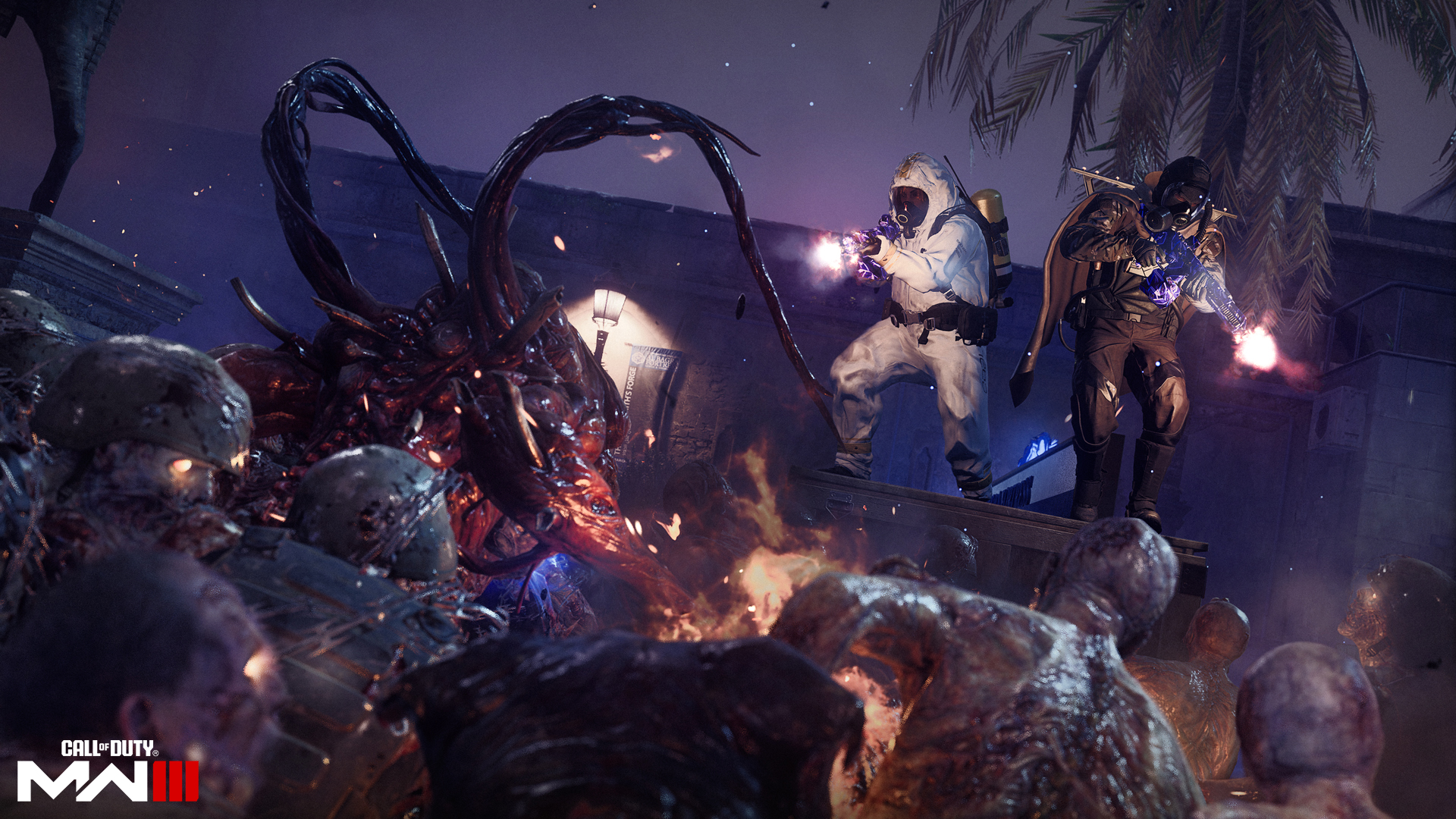
The Tranzit-inspired Ashes of the Damned is a triumph. It’s a road trip through the Dark Aether featuring six unique areas built for round-based slaying. From the rustic Confederacy-era town of Ashwood to the battlegrounds of the Orda Graveyard, every inch of the map shows signs of gorgeous decay. The traversal mechanics, by which a map like this lives or dies, are perfect. Ol’ Tessie, the drivable “Wonder Vehicle”, lets you move safely through the fog, while jumppads ensure you’re never far away from any of the key locales. There’s enough friction to keep you on your toes, but not enough where you’re frustrated at traipsing across the map.

Ashes’ main quest brings back the complexity that hardcore Zombies players have craved for years, and it’s designed so they can continuously discover new ways to optimise steps for future runs. With Directed Mode from Black Ops 6 returning in Season 1, everyone will soon be able to experience the journey to purge Veytharion and find out exactly why Zombies still has its teeth in so many players seventeen years later.
For those who aren’t interested in learning the secrets of the Dark Aether and just want to slay Zombies, Survival Mode returns with the promise of new maps every season. The notorious Dead Ops Arcade, which has always been a nice palate cleanser for players looking for a small burst of Zombies action, returns for its fourth instalment. It’s as mayhem-filled as ever, and some shrewd additions like Gobblegums and the SlayerMart (a shop with over 70 upgrades) flesh out Dead Ops into a more substantial experience, if you want it to be.
Black Ops 7’s Zombies narrative recovers well from the rickety storytelling of Black Ops 6 Zombies, although newcomers will be as confused as ever. The newest version of the original crew makes a solid first impression, all feeling different from their Ultimis and Primis counterparts. There are still major lore discrepancies that need to be addressed, but I hope the Narrative Team can build on its momentum.
The real draw for Zombies diehards this year is Cursed Mode, which limits players to classic staples like the starting pistol and the old points system. The goal is to find and activate Relics, which inflict further restrictions in exchange for powerful rewards (think Hades’ Pact of Punishment system). This could easily have ended up a mess of old clashing with new, but the traditional points system sings alongside newer Zombies mechanics. Relic-hunting is precisely what Zombies fans are looking for, and at the time of writing, the hunt for the final totem is still ongoing. The Zombies Team has struck gold again. Hopefully, they’ll continue to support Cursed Mode alongside community feedback to craft a uniquely replayable experience. Investigating adding Cursed Mode to Survival maps is a promising first step.

When it comes to Zombies, launch is only the beginning. In fact, the cinematic for the first post-launch map, Astra Malorum, is out now (it’s out of this world). It’s been a topsy-turvy ride for fans of the undead since Black Ops 4, but it seems “just wait…” has finally paid off. Treyarch has created a Zombies mode that allows players of all skill levels to dive into the madness and lose themselves in it. It’s the quintessential Call of Duty Zombies experience.
We’re in the Endgame
Despite Black Ops 7’s best attempts, it is still a modern Call of Duty game, meaning almost every positive is undone by an eye-rolling misstep. The campaign takes risks that, whether born of creative ambition or excruciating time constraints, do not land. It’s for purists only and even then, most will walk away disappointed. Multiplayer is the closest we’ve come to reliving classic Call of Duty in the modern era, with its return to Open Matchmaking supported by sublime maps, inventive gadgetry and a meaty progression system. Zombies is the highlight and worth the price of admission alone, once again proving itself to be the pocket of Call of Duty where creativity can prosper (for now). A stacked free post-launch schedule awaits, meaning fans of the undead will keep coming back for more.
In my Battlefield vs Call of Duty article, I stated that Battlefield wouldn’t outsell Call of Duty. I expected Battlefield 6 to soar, but I may have miscalculated how many players are simply tired of Call of Duty. It’s unclear how many units BO7 has sold so far—physical sales are down from BO6 and Game Pass muddies the water—but EA has already declared victory. Who can blame it? Battlefield 6 has sold gangbusters, while Call of Duty’s reputation is in tatters. Activision only has itself to blame. I’d like to think this might humble the suits, but we know it won’t.
Still, I can’t help but wonder what a game that combines the best parts of Black Ops 6 and 7 might have looked like. If the Call of Duty mines hadn’t been working overtime, perhaps Treyarch and Raven could have delivered a single, uncompromised Black Ops experience to rival the classics, instead of two uneven entries. That’s not the world we live in, though, and if a global pandemic didn’t slow down the Call of Duty machine, nothing will. The decision-makers will learn the wrong lessons; they will chase new trends, extract as much money as they can from faithful players, and pile on more mandates, deadlines, crunch, and demands for content. Loads more content. Endless content. God, make sure there’s content. Contentcontentcontent.
I don’t know if Call of Duty is worth fighting for. It’s easy to drown in the negativity, especially when much of it is deserved. However, I cannot ignore the love and hard work that is still poured into a mode like Zombies—even if the era of live-service COD has compromised its sanctity slightly. Like the lost souls wandering the Dark Aether, the artistry buried beneath the sludge cries out. Maybe there’ll come a day when I ignore its call, but it won’t be this year.